
A private AI system running 20+ specialist agents — built entirely on local infrastructure
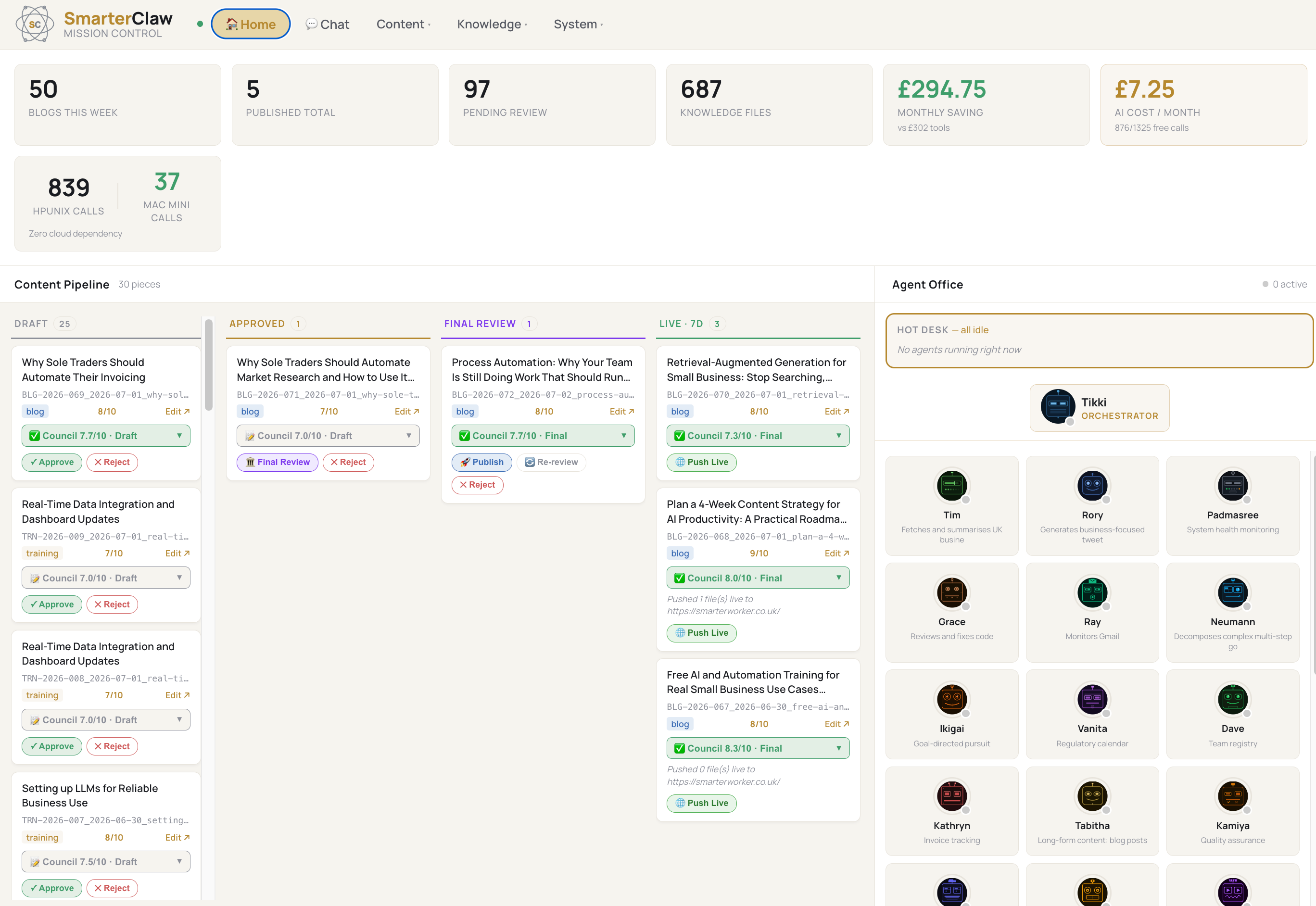
SmarterClaw is our own mission control system, built the same way we build for clients. Every agent, every workflow, every knowledge connection runs on hardware we own. No cloud API. No subscriptions. £7.25 per month in total AI costs.
The situation
Running a business that builds AI systems for clients creates an obvious question: what does your own operation actually look like? Every process we automate for others — content production, research, finance reporting, system monitoring — we were still doing manually or paying cloud tools to handle.
The cost was not just money. Every cloud AI tool requires you to hand over your data. Prompts, documents, client context — all of it leaving your system and sitting on someone else's servers. For a business built on the promise of private, on-premises AI, that was not acceptable.
We needed to build the same thing we sell. A private system, running on our own hardware, that handles the full operational load of the business without any external dependency.
What we built
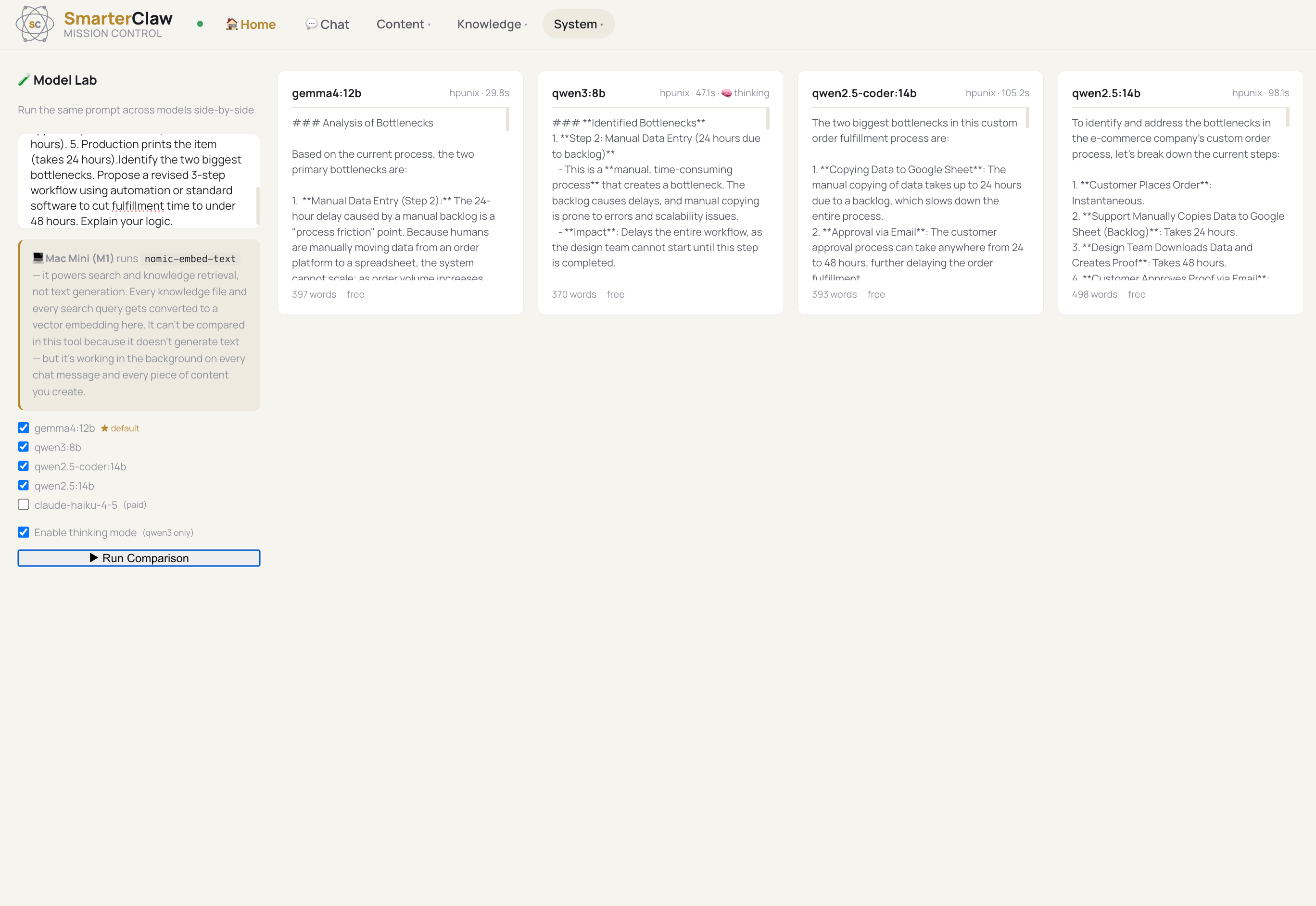
SmarterClaw is a Python-based mission control system that runs as a background service on a Mac Mini. All AI inference runs on a separate HP server with an NVIDIA RTX 3060 GPU and 31.2 GB of RAM. The two machines communicate over a local network. Nothing reaches the internet for inference.
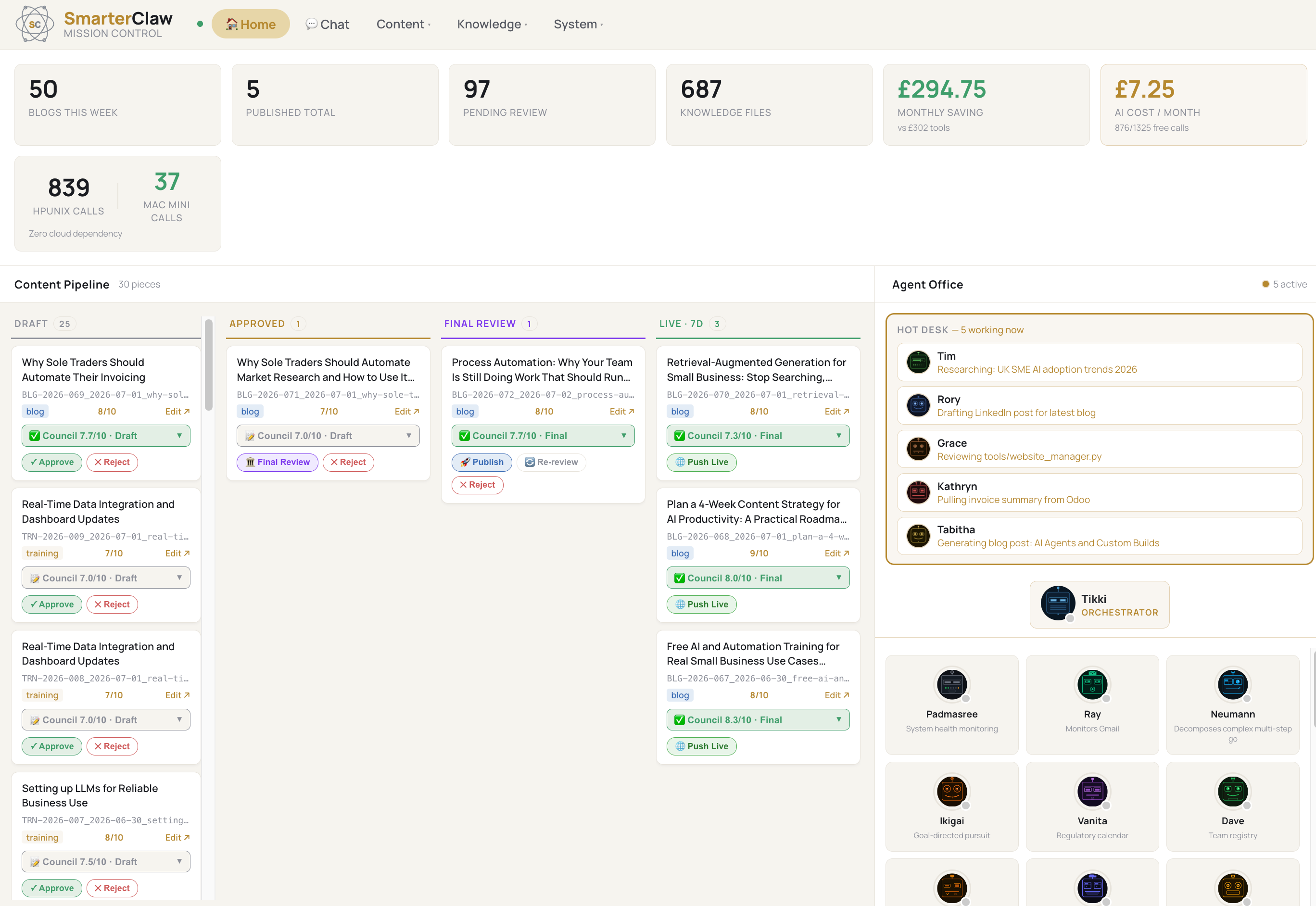
The system has 20+ named specialist agents, each responsible for a specific domain. Tikki is the orchestrator — every message or request routes through Tikki first, which classifies the intent and delegates to the right agent automatically. You never choose which agent to use.
The content pipeline
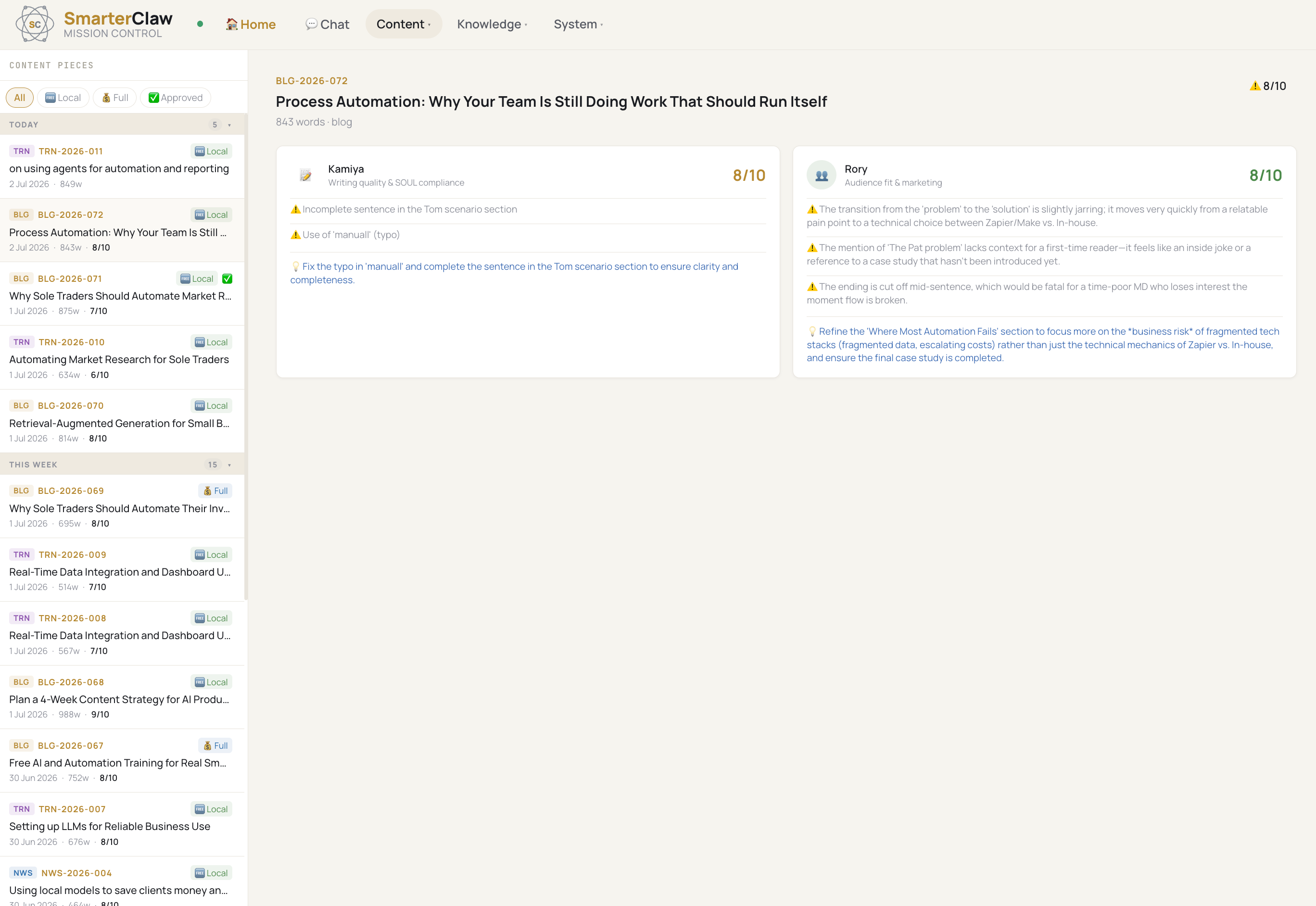
Every piece of content moves through a Kanban board: Draft → Approved → Final Review → Live. When a blog post reaches Final Review, it goes to the three-judge AI council. Kamiya scores brand voice and writing quality. Rory scores audience fit and marketing clarity. A third judge scores overall quality. Nothing ships until all three approve it.
Once approved, a single button pushes the content to the live website via SFTP. The system maintains SHA256 manifests for both the UAT and production environments, so only changed files are uploaded. A full 50-post week takes seconds to deploy.
The knowledge graph
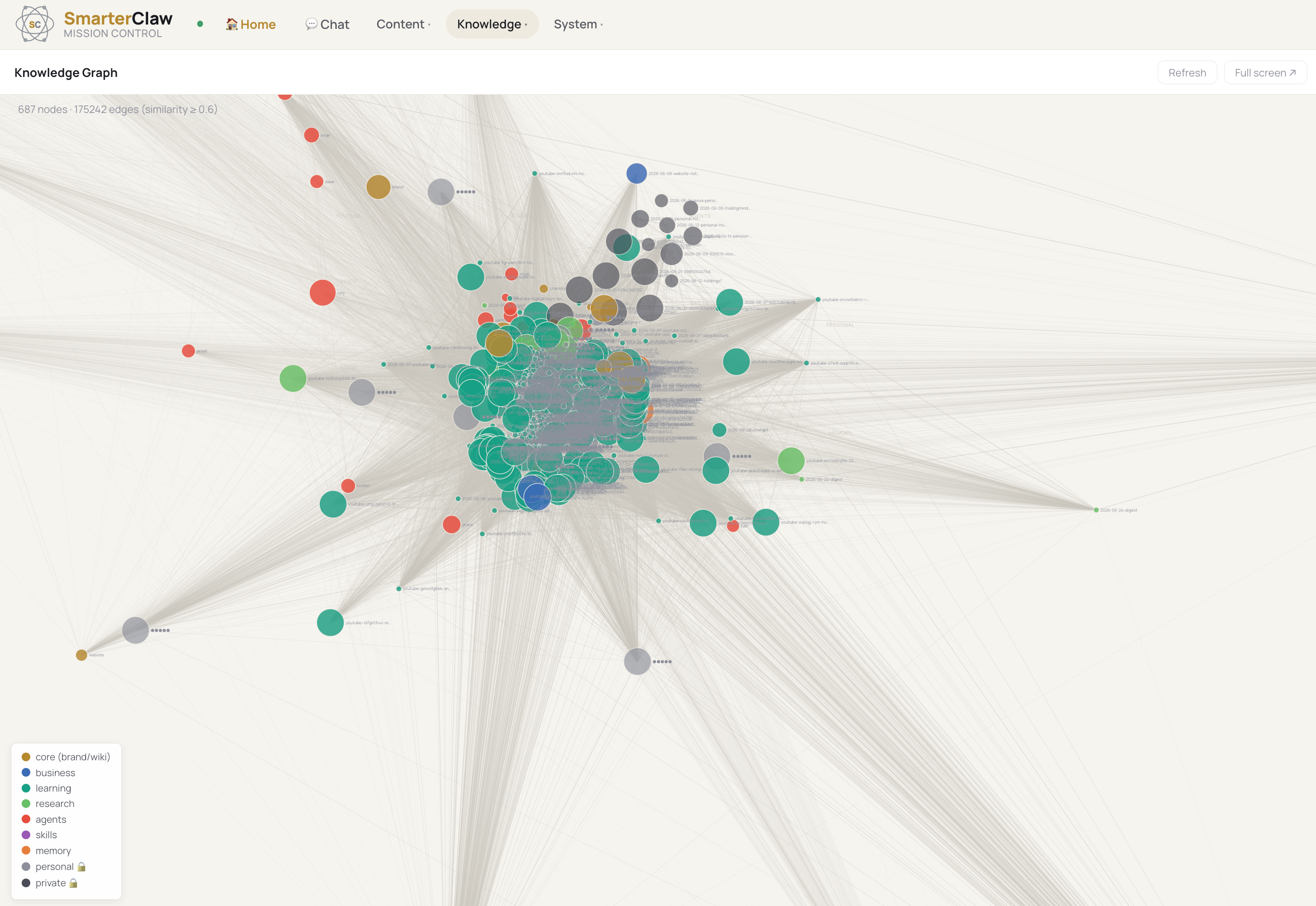
Every agent has access to 1,778 knowledge files across ten categories — brand guidelines, writing style, research, client context, regulatory references, and more. These files are embedded as vectors and stored in a local database. Before responding to any request, the agent retrieves the most relevant context automatically.
The knowledge graph maps 587 nodes with 175,242 semantic connections. This is visible in the dashboard as a live, explorable graph. Agents do not guess — they retrieve.
Why it matters for your business
We built this for ourselves first because we needed to prove it works before asking clients to trust it. Every limitation we hit, every integration we had to solve, every edge case in the content pipeline — we encountered it on our own operation, not on yours.
When we build this for a client, we know exactly what infrastructure is required, what the deployment looks like, and what it costs to run. The answer is: less than a SaaS subscription for a single seat of most AI tools.
Your business could run the same way.
Private AI. Your own infrastructure. No cloud subscriptions. We can build this for your team the same way we built it for ourselves.